We Rewrote The Test.
This post is what we found, what we changed because of it, and where you can start today for free.


For three years, the advice about getting good at AI has ended the same way: learn to prompt. Say the magic words. Phrase it better and the machine gets smarter.
The advice is right, as far as it goes. Prompting is the raw material of everything that follows; there is no skipping it. The problem is where the advice stops.
We spent this spring reading 918 honest conversations about how working people actually use AI. House painters. Fire chiefs. Consultants, bank executives, HR professionals, first-year agency hires. The data is blunt: the people pulling ahead prompt well, and then they refuse to let it end there. They turn what works into systems, verification, and workflows a colleague could run. The gap between them and everyone who stopped at the first rung is measurable, it is teachable, and right now it is not closing on its own.
This post is what we found, what we changed because of it, and where you can start today for free.
What 918 people said when the conversation got honest
An AI Cred assessment is a long, structured conversation about how you actually work with AI. It is not a quiz you can cram for. It asks what you do all day, how you delegate to AI, how you check its work, what has failed on you, and what you built after it failed.
Between November 2025 and June 2026, 918 of those assessments were completed on aicred.ai. We extracted and anonymized 17,667 individual facts from them, about 19 per conversation: the tools people use, the work they do, where it hurts, what they want next, and how they verify what AI hands them. Then we looked at what actually correlates with skill. The full research writeup is public here.
What makes this corpus different from every survey you have seen is the honesty. People tell an assessment things they would never put on LinkedIn: that they ship AI output they never check, that they secretly wonder if they are doing any of it right. One note on how we handle that candor: you will not see a single direct quote in this post. Even with permission, reading someone’s honest words back to the internet feels invasive, so everything here is aggregated and paraphrased.
That candor is the whole value. Nobody was performing. Which is why what the data shows deserves your attention.
The divide is 2.6 points wide
Every assessment produces a score out of 10. When we sorted all 918 conversations by how people actually work, three populations fell out:
Chat-box users (21.5% of everyone): open a chat window, type, copy the answer out, repeat tomorrow from scratch. Average score: 5.33.
Systematizers (52.5%): reusable prompts, templates, custom instructions. Beginning to save what works. Average score: 6.87.
System builders (25.5%): workflows a colleague could run, agents, verification built into the process. Average score: 7.90.
From the bottom group to the top is 2.6 points on a 10-point scale. That is a canyon, and it is structural. People whose conversations showed chat-only usage averaged 4.96 while everyone else averaged 7.02. And the correlation runs one direction with almost no exceptions: every reusable structure a person builds shows up as a higher score. Saved templates, documented processes, custom agents, feedback loops. The people running autonomous agents averaged 8.1. The people with verification designed into their workflow averaged 8.0.
None of this replaces prompting. Every one of those structures is made of it; a workflow is prompts with a spine, and an agent is prompting you did once and never have to repeat. The divide is between people whose best prompts evaporate when the chat ends and people who turn them into something that lasts.
The part that should actually worry you
Here is the finding I keep coming back to. If the divide were about raw capability, you would expect it to close on its own as the tools get easier. The tools got dramatically easier over the study window. The divide did not move.
Builder share by quarter: 23.5%, then 26.6%, then 26.0%. Flat. Three quarters of the fastest tool improvement in the history of the industry, and the share of people who build systems barely twitched.
That flatness means the divide is an education gap, not a capability gap. Builders are not smarter, and nothing about building requires an engineering degree. What builders had was somewhere to learn it. Almost nobody else does: 47% of the people we assessed taught themselves by trial and error, and under 9% ever took any formal training. The most common learning resource in the entire corpus was guessing.
One pattern repeated across the corpus in a hundred different phrasings: people saying they have no idea whether they are doing any of this right, because there is nobody in their life to compare notes with. Not an outlier confession. The median experience of a working professional in 2026.
Pain does not go away as you improve. It climbs a ladder.
Sort the pain points by score band and a shape appears.
People scoring under 5 fight the basics: generic output that sounds like everyone else (23.8% of their reported pain) and not knowing how to construct the ask (20.2%). People scoring above 7.5 have entirely different problems: hallucination they now catch (24.4%) and context falling out of long working sessions (12%). The bottom of the ladder struggles to get anything good out of AI. The top struggles to trust and scale what they get.
This is genuinely good news, and almost nobody frames it that way. Pain that changes as you climb means there are rungs. You are not standing in front of a wall. You are standing in front of a ladder nobody handed you.
The sharpest single rung is verification. People with no checking process at all averaged 5.14. People who verify by gut feel averaged 5.45. People who cross-check across models averaged 7.31, and people with named verification loops built into their process averaged 8.0. And one result that surprised us: carefully re-reading everything by hand correlated slightly below average. Vigilance that lives in your head does not scale. Verification that lives in the structure does.
Everyone at the top is asking for the same thing
When we pulled the feature requests and wishes out of all 918 conversations, the top asks were workflow templates, documentation tools, prompt libraries, and ways to share working systems with a team. Different words, one sentence: help me turn what works into something reusable.
Read that against everything above and the whole study collapses into one line. The divide is structural, the ladder is climbable, reuse and verification predict scores better than anything else, and the people living it are already asking for exactly this. Meanwhile, nearly every measure of “AI skill” on the market, ours included until recently, still treated prompt quality as most of the story instead of the foundation of it.
You can see where this is going.
We Rewrote The Test
AI Cred’s original rubric put Prompt Mastery at 40% of your score. Prompting has not stopped mattering; it is what every other skill in this post is built from. But after 918 conversations, one thing was clear: weighting it at 40% rewarded stopping at the first rung, and the divide in the data lives in everything above that rung.
The 2026 skills-era rubric measures whether you can turn AI into a system that works for you:
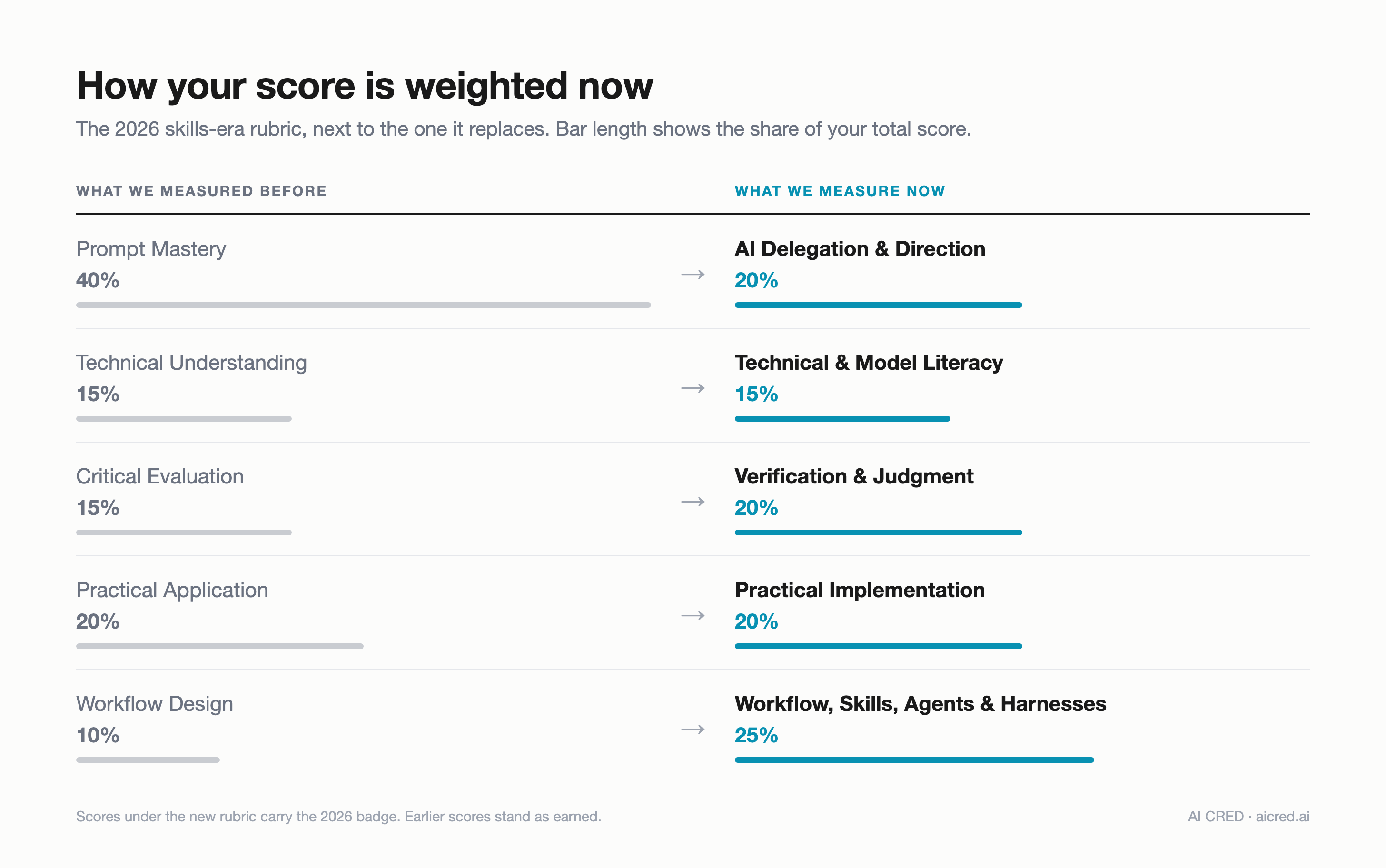
Notice what moved. Prompting did not shrink in importance; it graduated. It now lives inside delegation: knowing what to hand AI, how to direct it, and crucially when not to use it at all. And it is load-bearing in every dimension on the right side of that table, because you cannot verify, implement, or build a workflow without it. Verification rose because the data screamed that it should. The single largest weight in your 2026 score is the thing the study says separates the top from everyone else: whether your prompting compounds into workflows, skills, agents, and harnesses that outlive the chat window.
Scores earned under the new rubric carry a 2026 badge. If you took your assessment before the change, your score stays valid and stands as earned. When you are ready to see where you stand on the new bar, the reassessment is waiting on your dashboard.
The one question that predicts more than any other
Out of everything in 918 transcripts, one question separated skill levels more cleanly than any other:
Could a colleague run your workflow without you?
If yes, you have built an asset. It compounds, it transfers, it survives your vacation. If no, whatever skill you have is trapped in your own head, and every Monday you start over. The 2026 assessment now asks this directly, because the data says it is the closest thing to a single measure of where you really are.
Sit with that question for a second before you read on. Your honest answer is a preview of your score.
What AI Cred is actually about
Here is the conviction under all of this, stated plainly.
AI fluency is judgment, delegation, verification, application, and workflow design. It is not tool collecting, course certificates, or vibes. And the point of getting fluent was never to hand your work to a machine. A writer wants to write. A teacher wants to teach. A photographer wants to make photographs. Fluency clears the sediment, the reformatting, the status updates, the same email rewritten in three tones, so the part of your work you love gets bigger. That is the whole mission.
Which is why the score was never the product. The score is the key. It unlocks a learning plan built from your actual conversation, aimed at your actual gaps, one rung at a time. Measurement exists so you can grow, and leveling up is meant to be celebrated. The study gave us the map of where 918 real people get stuck. The assessment tells you where you are on that map. The learning plan walks you up the ladder.
But all of that presumes you already know where AI fits your work. The data says most people never got that far. So we built something for the very first step, and we made it free.
If you are staring at the blank box, start here
The most common first experience with AI goes like this: everyone says just start using it, you open the tool, the cursor blinks, and you realize you do not know what to ask. So you close the tab and quietly file yourself under “not an AI person.”

That was never your failure. That was a design flaw. A blank prompt box assumes you already know where AI fits your work, and that is precisely the thing almost nobody knows yet.
Spark reverses the interview. It is a short, free conversation where the AI asks about you: what you actually do all day, what eats your time, and what you love about your work enough to protect. Then it writes you a personal report with three things in it:
The hours. Which parts of your specific week AI can quietly hand back.
The openings. Directions your skills could go that you had not thought to look for.
The line. A straight answer about what AI will not do for you, said plainly, so you can stop wondering.
That third section is the one people tell us they did not know they needed. Every tool on the internet promises AI changes everything. A map with only green lights is not a map. Spark tells you no, specifically, about your own work, and that is exactly why you can trust where it says yes.
Spark is free because it is the right first step, and gating the first step is how the last decade of “access” went wrong. No credit card. Two reports with your account, yours to keep. A few minutes of honest conversation.

Get your free Spark report → aicred.ai/spark-ai
A year from now
Play the study forward twelve months.
The builder line has been flat for three quarters because nobody made the climb legible. We rebuilt our assessment so the climb is measured honestly, we tied a learning plan to every score so the next rung is always named, and we made the first step free so the door has no cover charge. The success metric we set for ourselves is public and it is simple: that flat line starts to slope.
Where you enter is up to you, and both doors are real. If AI still feels like someone else’s party, start with Spark: three minutes, free, and you will walk away with a map of your own work. If you already have systems and want to know where you truly stand, take the 2026 assessment and get the score with the badge on it.
A year from now there are two versions of you. Same talent, same job, same week. The only difference between them is which one found out where AI fits their work while early still counted.
We will keep publishing what the data shows as the 2026 scores come in, including the moment that builder line finally moves. Subscribe and you will see it move first.
On it..
The colleague test kind of predates AI... Plenty of people couldn't have handed off their 2021 workflow either. I retype basically the same prompt most mornings so I know which bucket I'm in. Makes me wonder how much of that flat gap is education vs. jobs that just never reward handing anything of.